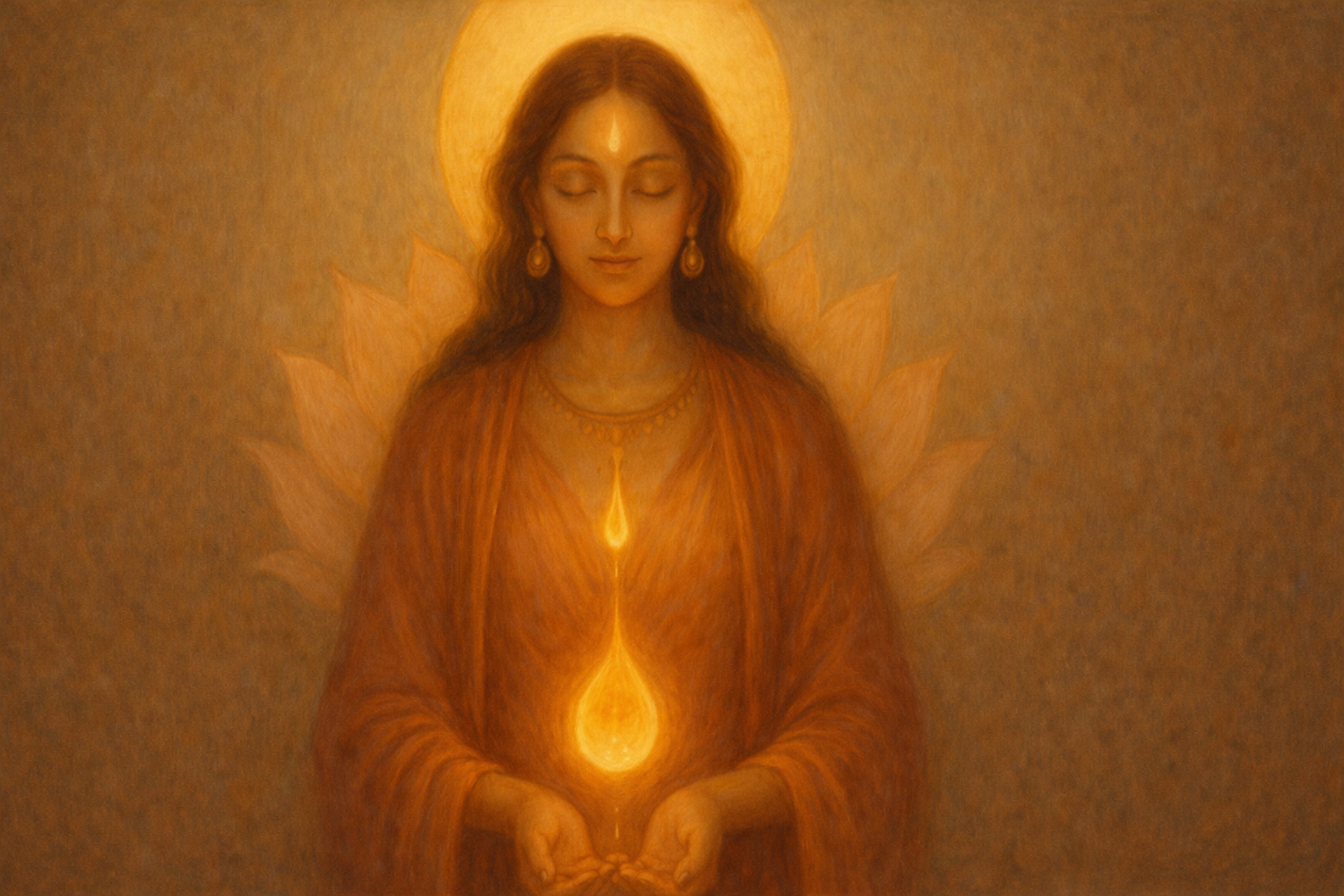
What is Amrita Nectar? Tracing the Divine Substance of Immortality
Table of Contents
In Sanskrit, Amṛta literally means immortality, with a meaning 'not' and mṛta meaning 'death.' In Vedic and Tantric traditions, Amrita is the divine nectar said to flow from the heavens, from the crown of an awakened being, and even from the human body itself. It is a symbol of eternal life, and a lived experience of divine essence and consciousness pulsing through form.
In Hindu mythology, Amrita first appears as the elixir churned from the cosmic ocean, the substance for which gods and demons waged war. In yogic and Tantric philosophy, it is secreted by the body in states of deep meditation or ecstatic union. And in spiritual practice, it is recognized as the inner nectar that dissolves the fear of death, allowing one to taste eternity while still alive.
Amrita in Hindu Mythology
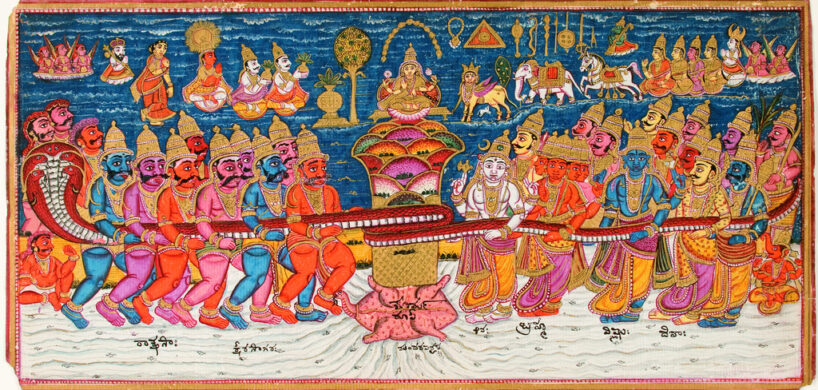
The story of Amrita begins with the Samudra Manthan, the great churning of the cosmic ocean. Gods (devas) and demons (asuras) came together in a rare alliance, wrapping the serpent Vasuki around Mount Mandara and using it as a churning rod. Their goal was to bring forth the Amrita, the nectar of immortality said to grant eternal life to whoever consumed it.
As they churned the vast Kshira Sagara, the Ocean of Milk, treasures and beings of unimaginable beauty emerged. But from the depths also rose Halahala, a poison so potent it threatened to destroy all creation.
In an act of selfless grace, Lord Shiva gathered the poison into his palms and drank it whole, holding it in his throat so that it would not harm the world. The poison turned his skin blue, earning him the name Neelakantha, the Blue-Throated One.
Only then did the long-awaited Amrita surface, luminous, golden, and brimming with the essence of eternity. Lord Vishnu carried the nectar, but as soon as it appeared, a fierce battle broke out between gods and demons over who would claim it. To restore order, Lord Vishnu took the enchanting form of Mohini, a divine temptress of such beauty that even the gods forgot themselves. With her grace, she distracted the demons and served the Amrita only to the devas, ensuring the balance of divine order.
Amrita in Hindu Philosophy
The human body, too, is seen as a living universe, complete with its own mountains, channels, and tides. Within this inner universe flows a subtle current known as the Amrita Nadi, a luminous thread said to connect the crown of the head with the heart. Through this channel, the nectar of immortality trickles down from the higher centers of consciousness into the temple of the body.
In the deepest states of meditation, yogis speak of a sweetness at the back of the throat, a divine secretion said to descend from the head and pass through the upper epiglottis. This nectar is Amrita. To taste it is to glimpse the body’s own capacity for transcendence, the way divinity reveals itself not beyond the flesh but through it.
Tantric and Hatha yoga traditions offer subtle ways of cultivating this flow. Jalandhara Bandha, the throat lock, is practiced to “catch” the nectar, preventing it from being consumed by the digestive fire. By concentrating prana in the Vishuddhi Chakra, practitioners refine this essence, transforming it from physical substance into spiritual nourishment. Turning the gaze inward toward the Ajna (third eye) preserves the upward current, and this is where immortality begins.
In these moments, the yogi is said to be sustained not by food or water, but by consciousness itself. Amrita thus becomes both symbol and proof that the human body, when attuned, is capable of generating divine sustenance.
Amrita in Buddhist Philosophy and Tibetan Buddhism
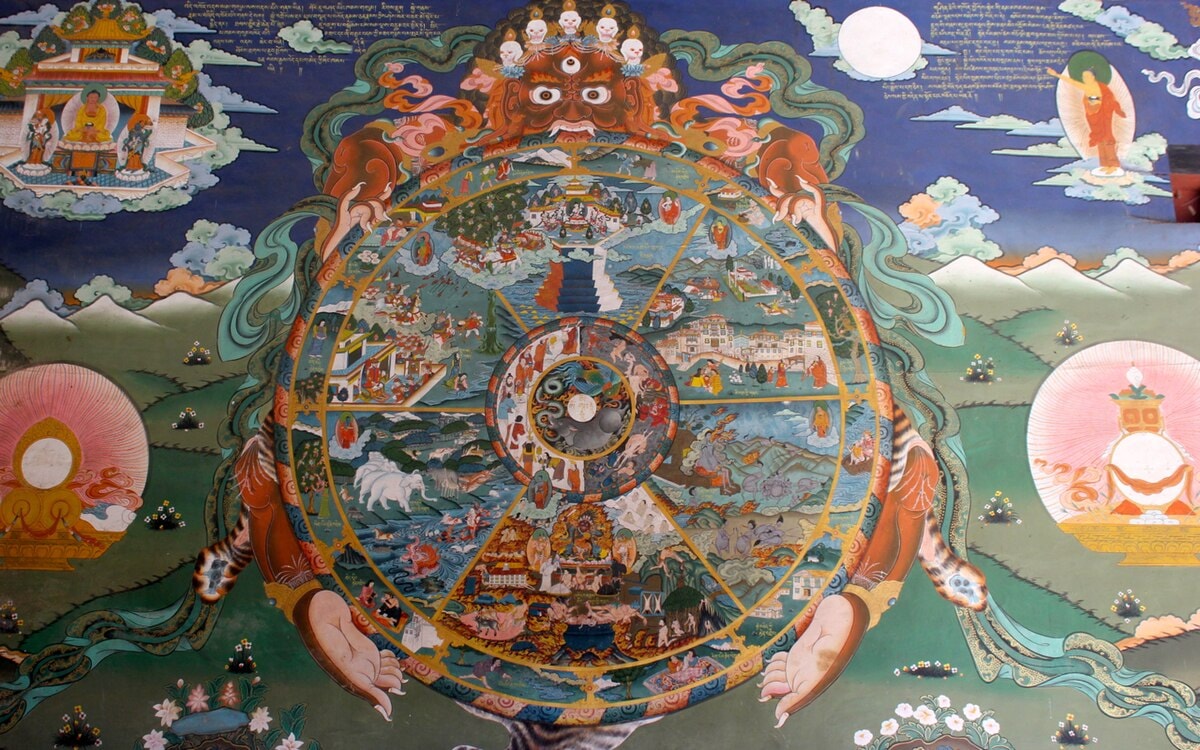
The six realms of existence in which a sentient being can reincarnate
In early Buddhist philosophy, Amrita is no longer a nectar to be found, but a state to be realized. The Buddha spoke often of the deathless, Amata in Pali, referring to the awakened condition that lies beyond the endless turning of birth and death known as samsara. This “deathless state” is what he called Nirvana, the direct experience of freedom when the fires of craving and ignorance are finally extinguished.
To “taste Amrita,” then, is to experience the stillness that arises when the struggle to become dissolves. Just as the gods once churned the ocean to reveal the nectar of immortality, the practitioner churns the ocean of consciousness through meditation, discovering that the true Amrita was always within.
As Buddhism evolved into its tantric and esoteric forms, especially in Vajrayana and Tibetan lineages, Amrita reappeared as a tangible sacred substance. In these traditions, Amrita is a consecrated nectar prepared through elaborate alchemical rituals. It is composed of grains, herbs, minerals, and relics, all infused with mantra and the intention of awakening. This nectar is offered in skull cups (kapala) during empowerment ceremonies, where it symbolizes the transmutation of ignorance into wisdom. When a practitioner partakes of Amrita, they symbolically “drink” spiritual enlightenment.
Amrita in Greek Mythology
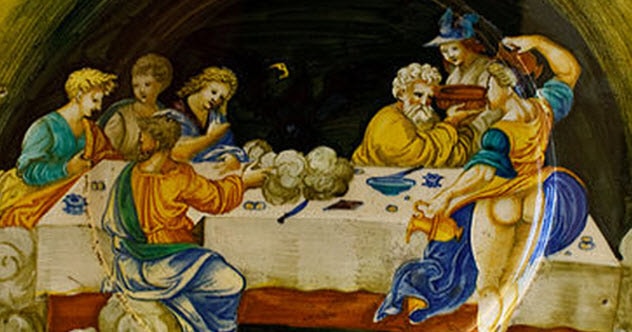
Across the world from the Vedic seers, the ancient Greeks spoke of another divine sustenance, Ambrosia and Nectar, the food and drink of the Olympian gods. Poured by Hebe or Ganymede at celestial banquets, Ambrosia was said to keep the gods forever radiant, untouched by age or decay. It perfumed their skin, healed their wounds, and let them obtain immortality. Even the goddess Athena, guardian of wisdom, was described as anointing heroes with ambrosia to preserve their beauty and vitality.
Linguistically Ambrosia mirrors Amrita with both names born from the same ancient Indo-European root meaning “immortal.” In Greece, Ambrosia is a nectar of pleasure and vitality that sustains the eternal feast of Olympus. In India, Amrita refers to a nectar of liberation that frees the individual soul from the endless turning of rebirth.
Both reveal a shared human yearning to taste something that outlives decay, to be filled with the essence of the eternal.
Amrita in Tantra
In Tantric teachings, Amrita is a living essence flowing through the awakened body. Within Kaula and Shakta Tantra, this nectar is identified with the sacred fluids of the feminine, the yoni amrita that may arise during states of deep pleasure.
In certain esoteric rites, this fluid was collected and revered as the nectar of immortality, believed to carry the vibrational imprint of awakened Shakti, the life-force of creation itself. To taste or anoint oneself with Amrita was a way of receiving the goddess through the body.
When Amrita is experienced, whether as a physical secretion or as the subtle nectar that drips through the Sushumna Nadi during meditation, it symbolizes the melting of the individual self into the divine. To “drink” Amrita is to die to the ego, and be reborn as consciousness itself.
Tantric texts describe how, when prana rises through the central channel and unites with the crown, the nectar begins to flow. It descends as a cool, blissful liquid sometimes felt at the back of the throat, sometimes pulsing through the womb or heart.
The Human Body and the Production of Amrita
In yogic and Tantric physiology, the body is viewed as a living temple where divinity distills itself into form. At the center of the head, the pineal and pituitary glands are often called the “nectar glands.” These small but potent organs are said to secrete subtle essences that, when awakened through meditation or breathwork, become the Amrita, the inner elixir of immortality.
As kundalini shakti rises through the Sushumna Nadi, she coils upward through the spine and gathers in the crown. There, the nectar is said to pool in the upper coil of energy, illuminating the mind. When the inner fire stabilizes, this Amrita begins to drip downward, passing through the throat center, activating the Vishuddhi Chakra, and manifesting as a sweetness on the tongue. Many yogis recognize this taste as confirmation that their life force has become refined into spirit.
In the feminine Tantric path, this same principle is experienced through the body’s sacred fluids. Practices of breath, sound, and internal massage, sometimes using crystal wand tools (Like the Amrita® Wand) can help release the deep muscular and energetic contractions that hold Shakti in dormancy. When these channels open, a woman may experience a subtle nectar flowing from within her womb-space.
The Taste of Divine Nectar: Pleasure, Healing, and Bliss
When Amrita finally reveals itself, the experience is said to be unmistakable. Yogic texts describe it as madhura rasa, a honey-like sweetness that seems to arise from nowhere and everywhere at once.
Yogis speak of waves of joy and a serene radiance spreading through the body as the nectar flows. The mind stills and the body becomes light. In ancient accounts, those who tasted Amrita could meditate or fast for long periods, nourished by the essence of consciousness itself.
To taste it is to experience the meeting of spirit and matter, the point where ultimate reality seeps into physical form.
Negative Aspects & Cautions in Ancient Teachings
In every telling of Amrita, there is a shadow. The nectar of immortality rises from the same ocean that births deadly poison. In the Samudra Manthan, Halahala, the deadly toxin, surfaced before the divine elixir could emerge.
The body and mind must be prepared before Amrita can be safely contained. When the channels of prana are blocked, when ego or desire dominates the practice, the nectar said to drip from the crown may instead be “burned” by the inner fires of digestion, transformed from ambrosia into waste.
Ancient texts therefore emphasize patience, purification, and proper guidance. Amrita and Halahala are never truly separate. The nectar is born only when one learns to hold both, the pleasure and the peril, the radiant bliss and the burn, within the same vessel of consciousness.
Conclusion
Across time and tradition, Amrita has taken many forms. It was the nectar churned from cosmic oceans, it became a subtle secretion of the awakened body. It is the deathless state itself, and it flows through the feminine body as the elixir of ecstasy.
Amrita is the pulse of life when it remembers its own eternal true nature. Sometimes it is felt as a sweetness in the throat, sometimes as bliss rising through the spine, and sometimes as the sacred fluid that pours forth when the body surrenders. It may come as peace, or as pleasure.
However you find your way to it, know that the nectar of immortality flows through you, in every cell, and in every moment you meet yourself with presence.